Compare the best RV and motorhome rentals in Reykjavik & Keflavik. Class C motorhomes with bathroom, full kitchen, heater and sleeping for 4–6 — best price guaranteed on Ring Road, Golden Circle & Northern Lights trips.
 Keflavik Airport

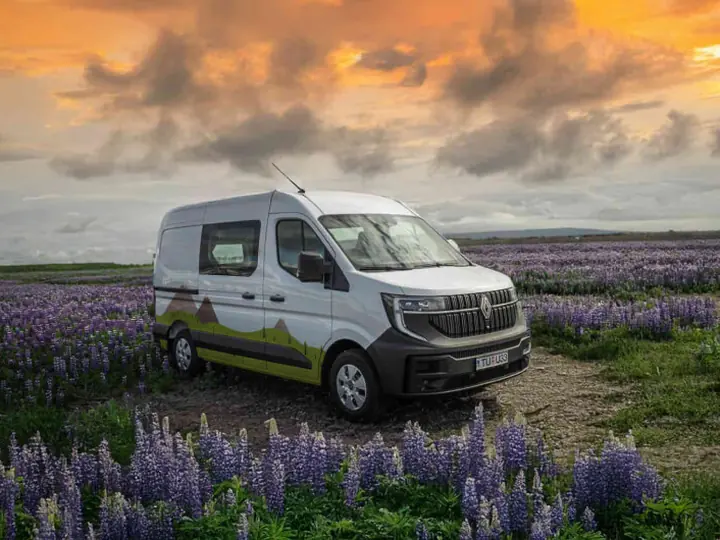
Nimbler 2–3 berth campervans. Easier to park, better fuel economy, lower daily rates — ideal for couples on a budget Ring Road trip.
See Iceland campervans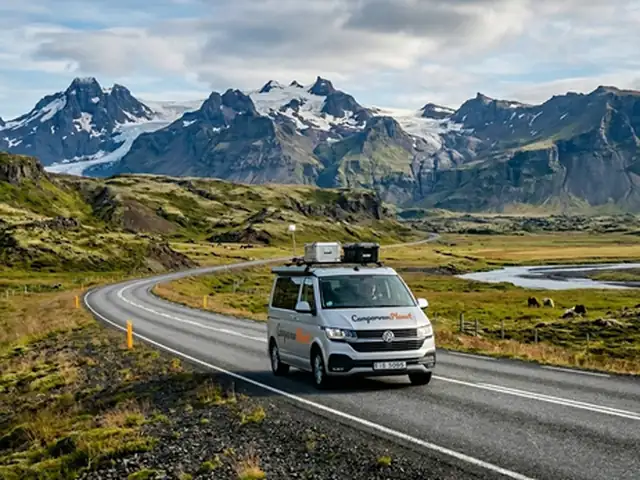
Highland-ready 4x4 campervans with high clearance and all-terrain tires — the only legal way into Landmannalaugar, Þórsmörk and the F-roads.
See 4x4 campervans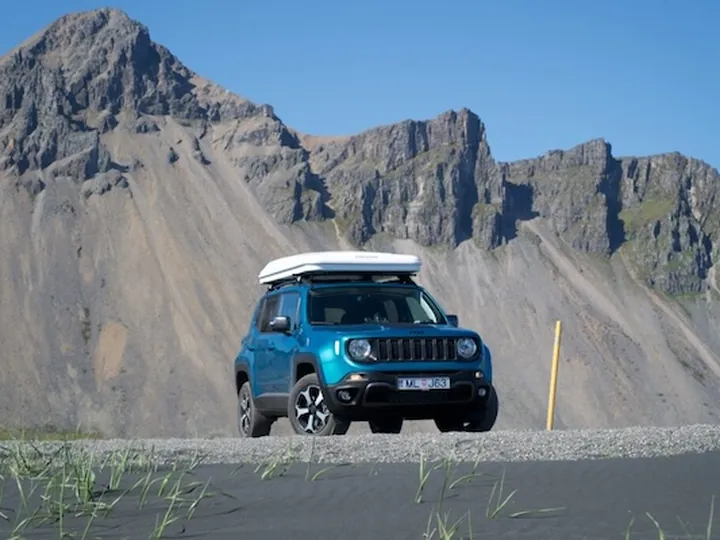
Compact 4x4 SUVs with a pop-up roof top tent. Sleep above the vehicle, drive light during the day, and wake up to midnight sun or aurora.
See rooftop tentsPick the right season for your Iceland motorhome road trip.
Temp: 12-20°C • Daylight: 18-22 hrs
Peak season with continuous daylight, all attractions open, accessible Highlands (F-roads), and optimal hiking. Weather stable but variable. Crowded, higher prices, busy campsites. Book in advance.
Peak Price: €199-299/dayTemp: 8-15°C • Daylight: 14-18 hrs
Extended daylight, mild weather, accessible Ring Road, fewer crowds. May has spring blooms; September shows fall colors and early aurora. Excellent balance of conditions and availability.
Best Value: €119-179/dayTemp: 0-8°C • Daylight: 8-14 hrs
October: Northern Lights begin, fewer tourists. April: Spring awakening, melting snow, muddy roads. Winter tires required Oct-Apr. Ring Road fully accessible (usually). Variable weather, moderate prices.
Moderate: €149-199/dayTemp: -5 to 5°C • Daylight: 3-7 hrs
Peak Aurora viewing (Dec-Jan best), near-total winter darkness, snow-covered landscapes, and budget prices. Challenging weather, some roads closed, ice hazards. 4x4 strongly recommended.
Budget: €119-159/dayChoose your preferred rental location across Iceland.
Most popular • 45 min from Reykjavik • Direct from international flights
Capital • Main hub • Best for exploring downtown and nearby sites
Domestic flights • Closer to city center • Shorter transfer time
Alternative • Coastal town • Greater access to south coast routes
North Iceland • Perfect starting point for northern adventures
East Iceland • Gateway to Eastfjords and waterfalls
From compact 4-berth motorhomes to family Class C RVs with a full wet room.
Entry-level motorhome. Cassette toilet, 2-burner hob and fridge. Easier to drive than a full Class C, ideal for two couples on the Ring Road.
Proper bathroom with flushing toilet and shower, 4-burner stove, fridge-freezer, cabin heater and overcab double. The standard choice for Iceland comfort travel.
Separate rear double, overcab double and dinette conversion. Dedicated wet room, 100L fridge, oven and extra storage. Built for families of 4-6.
Fixed rear island bed, island kitchen, full-size wet room, diesel cabin heater and solar panel. No bed conversions. Ideal for slow-travel Ring Road trips.
Everything you need to know before renting a motorhome in Iceland — from licence rules to bathroom specs.
Ready to Explore Iceland in an RV?
Compare Iceland motorhome fleets, find your best daily rate, and hit the Ring Road with a full kitchen, bathroom and heater on board.
Search RVs NowIceland's dramatic landscapes, volcanic terrain, and ever-changing weather make it one of the most extraordinary countries to explore by campervan or motorhome. Whether you're driving the Ring Road or venturing into the remote Westfjords, here's everything you need to know to plan the perfect trip.
Iceland drives on the right-hand side, the same as continental Europe and North America. Every motorhome or Class C RV in the Icelandic rental fleet sits on a 3,500 kg chassis, so a standard category B driving licence covers the entire range — no C1 upgrade needed. That said, Iceland's roads are physically narrower than the autoroutes travellers are used to (typical width is 6.5 m with no hard shoulder) and a 7 m Class C motorhome feels bigger on them than back home. Your first hour out of Reykjavik is the adjustment window: test the wing mirrors, brake gently, and sit at 70 km/h until the vehicle feels predictable.
Every RV rental in Iceland sits on one of three chassis — Fiat Ducato (most common), Mercedes Sprinter (premium), or Ford Transit. All handle similarly; the only material difference is the turning circle (Sprinter is the tightest).
Iceland's Ring Road has 30+ single-lane bridges (Einbreið brú), concentrated along the South Coast between Skógar and Höfn and along the Eastfjords. First vehicle to the bridge has legal right of way, but a motorhome takes longer to stop than a car — when in doubt, yield early. Flash your headlights once if you do. Oncoming traffic knows to clear the bridge when they see the RV silhouette approaching.
Blind crests (Blindhæð) are equally common. Slow to 60 km/h at the yellow sign, stay dead-centre in your lane, and expect livestock or tourists on the other side. Sheep roam freely across the countryside from June to September and wander onto the road without warning.
Iceland's F-roads (fjallvegir) cross the interior Highlands — Landmannalaugar, Askja, Kjölur, Sprengisandur, Þórsmörk. They are unpaved, crossed by unbridged rivers, and legally restricted to 4x4 vehicles with high ground clearance. Every Class C motorhome, Family Motorhome and Luxury Motorhome in Iceland's rental fleet is 2WD. Taking an RV onto an F-road violates Icelandic traffic law and voids 100% of your insurance. Every major rental operator in Iceland has a GPS tracker in their motorhome fleet that cross-checks against the F-road database on return.
If Landmannalaugar or Þórsmörk are on your list, the fair workaround is to park at the nearest Ring Road campsite (Hella for Þórsmörk, Hrauneyjar area for Landmannalaugar) and join a super-jeep day tour. Or switch vehicle category entirely — the Iceland 4x4 camper rental fleet is built for F-roads, and the Iceland campervan rental page has 4x4 conversion options too.
Iceland's wind is what catches first-time RV drivers off guard. A Class C motorhome has roughly 15 m² of side surface exposed to the wind. At 25 m/s crosswinds (90 km/h gusts) the lateral force on the side of your vehicle equals a small car's frontal crash area. That's how motorhome doors get ripped off on the Reykjanes peninsula every summer when travellers open the habitation door into the wind.
Three hard rules:
Class C motorhomes in Iceland average 12-16 L of diesel per 100 km. A full Ring Road (≈1,350 km) at €1.85-2.00/L costs roughly €300-430. The gaps that catch travellers out:
All rural pumps are unmanned self-service and require a chip-and-PIN card. Visa and Mastercard work reliably; American Express is hit-and-miss at N1. Carry a back-up card. The three main chains are N1, Orkan and Olis — N1 has the widest coverage and the N1 app shows live pump availability plus a kronur-per-litre discount.
Iceland has no road tolls on the Ring Road. The only paid passage is the Vaðlaheiðargöng tunnel near Akureyri (ISK 1,500 / ~€10, paid online at tunnel.is within 24 hours). Parking at major attractions (Gullfoss, Seljalandsfoss, Skógafoss, Reynisfjara) charges €5-7 for the upkeep of facilities. Most have paved bays sized for motorhomes.
In Reykjavik itself, street parking is metered in zones P1 (red, most expensive) through P4 (blue, cheapest). For a motorhome visitor, the practical solution is to park overnight at Laugardalur campsite (year-round, on the city's east edge) and bus or walk into 101 Reykjavik — a 25-minute walk or a 15-minute bus ride.
Iceland prohibits overnight parking outside official campsites — even for fully self-contained motorhomes with sealed grey-water tanks. The rule is the Nature Conservation Act §31 and it applies to every RV, every night, regardless of vehicle size or class. Wild camping for tents has a narrow exception on public land; anything on wheels must sleep inside a registered campsite. Fines start at ISK 10,000 (~€70) and escalate.
Iceland's campsite network has 170+ registered sites, ranging from basic (pit toilet, fresh-water tap) to full-service (electric hookups, heated wet-wash blocks, laundry, Wi-Fi). Typical cost per adult is ISK 2,000-3,500 (~€14-25) per night, plus extras. For motorhome rental travellers, the key amenities to look for are RV-suitable pitches, a fresh-water fill, and — on longer trips — a grey-water dump point.
Class C motorhomes in Iceland come self-contained — bed linen included, heating system running, hot water on demand, stove top with gas bottled, running water from the onboard freshwater tank, and a flushing toilet in the wet room. But three campsite services still make a multi-day trip comfortable:
A typical Iceland RV rental package covers almost everything: bed linen with pillows and duvets for each berth, a linen set per traveller (sheet, pillowcase, towel in premium packages), a heating system (Webasto or Truma diesel cabin heater with thermostat), hot water on demand via gas boiler, a stove top (4-burner on Class C, 2-burner on compact), running water from the freshwater tank, a full kitchen kit (pots, pans, cutlery, plates, wine glasses, kettle), gas for cooking, cabin heater fuel, and basic cleaning supplies.
Items you pay for on top: second-driver registration, GPS (most travellers now use phone navigation), camping chairs and table (ISK 2,500/week), a Camping Card, and optional insurance upgrades.
Most rural campsites operate mid-May to late September only. The year-round sites — Reykjavik Laugardalur, Hella, Skaftafell, Mývatn Hlíð, Akureyri Hamrar — are your winter bases. This matters because:
The Iceland Camping Card costs ~€180 per card and covers 28 nights at 40+ participating campsites — including Hella, Egilsstaðir, Akureyri and several smaller rural sites. If you're doing 10+ nights in Camping-Card sites on your motorhome rental trip, it pays for itself by night seven. If your itinerary mixes in many non-Camping-Card sites (Skaftafell, Mývatn Hlíð, Landmannalaugar are not covered), do the maths per trip — it's not always the best deal.
The good news: 90% of Iceland's iconic sights sit on paved roads with RV-sized parking. Gullfoss, Geysir, Seljalandsfoss, Skógafoss, Reynisfjara black-sand beach, Jökulsárlón glacier lagoon, Diamond Beach, Dettifoss (west side), Goðafoss, Mývatn — all Class C motorhome accessible. The 10% you skip with a 2WD RV are the F-road destinations: Landmannalaugar, Þórsmörk, Askja, Kerlingarfjöll. Super-jeep day tours from Hella, Vík and Mývatn fill that gap while the RV stays at the campsite.
Iceland runs on geothermal water, and a soak at sunset is one of the great rewards of a motorhome road trip. All of these have motorhome-sized parking:
Aurora season runs late August through early April, with peak clarity November-February. The trick is patience: you need darkness, clear sky, and solar activity at the same time. Hotel-based travellers usually give up after one cloudy evening. A motorhome flips the math — you drive 30 minutes out of Reykjavik to a dark-sky campsite (Þingvellir, Grindavík area, Hvolsvöllur), cook dinner inside with the heating system on, and wait as long as the forecast takes. Most trips of 5+ winter nights in an RV rental see at least one strong aurora display.
The three apps to install: vedur.is aurora forecast (Icelandic Met Office, 0-9 KP-style scale), My Aurora Forecast (push notifications when activity spikes), and Cloud Cover Iceland (hourly satellite). Combine all three. KP above 3 + cloud below 40% directly overhead = drive out.
Be honest about where a Class C RV doesn't belong:
Motorhomes drive slower than campervans — not because the engine is weaker, but because the right daily distance for an RV in Iceland is 200-300 km. Any more and you rush past the sights you came for. Planning rules:
Under 6 days and half the trip is spent moving — not great value on a motorhome rental. If your window is a weekend, a hotel-based tour makes more sense; save the RV for a 10+ day trip.
Real-world budget for two adults, 10 days, shoulder season (May, September, October):
Comparable to a hotel-based 10-day Iceland trip — but with the motorhome you're paying for more comfort and flexibility rather than saving money. The clean RV saving appears if you're four people in a 6-berth motorhome: per-person drops 35-40% vs four hotel rooms.
Iceland's motorhome rental market operates two pickup models:
Both models cover the same vehicle, insurance and inclusions. Self-service rental usually saves 20-30 minutes of airport time at the cost of not having a walkthrough; bring a laptop or phone to watch the operator's vehicle-orientation video before you drive off.
Every Class C motorhome rental in Iceland includes: bed linen (pillows, duvets, sheets), a linen set per berth, hot water via gas boiler, a heating system (diesel cabin heater with thermostat), running water from the freshwater tank, a stove top (4-burner on Class C), fridge-freezer, kettle, full kitchen kit, and gas for cooking. Premium fleets add a microwave, TV and solar panel.
What to bring from home:
An RV rental in Iceland isn't always the right choice. If your trip has any of these characteristics, consider alternatives:
First-time RV drivers in Iceland make one predictable mistake: they plan the same daily distances they would drive at home. 400 km days work in France with motorway speed limits and straight autoroutes. In Iceland it means arriving at the campsite exhausted, in the dark, having seen nothing. Cap yourself at 250 km/day and your memories of the trip will be waterfalls, not kilometre counters.
Iceland's population is small (400,000-ish) but the event calendar is denser than travellers expect. These are the dates that pull enough visitors to move motorhome rental prices — book your vehicle 3-6 months ahead if your trip overlaps any of them, because Iceland's total RV rental inventory is capped and sells out early.
Motorhome rental rates in Iceland follow a clear pattern you can time around:
If your trip doesn't need a specific festival, the best RV months in Iceland — clear roads, open campsites, few tourists — are mid-September to mid-October and mid-April to late May. Rates drop 20-30% from peak, campsites are half-empty, the Ring Road is fully open. The trade-off: daylight is shorter, so plan 200 km days instead of 300 and aim to be parked by 17:00 in shoulder season.
A 3-4 day RV rental in Iceland is marginal — you use a full day each for pickup and drop-off, which leaves 1-2 days of actual touring. It works for Golden Circle + South Coast to Vík (~400 km round trip) or Reykjanes + Snæfellsnes shortcut. For anything further, extend to 6+ days or book a hotel-based alternative.
Explore the best places to rent an RV, motorhome, or campervan worldwide