English
The vehicle with the tent on top. Compare what is actually bookable.
First trip to Australia? US$50 off·NEW50
This is not a tent you strap to your own car: you hire the whole vehicle with the rooftop tent fitted, bedding inside and the kitchen kit in the back. Climb the ladder, sleep above the ground, fold it away and drive.
The tent travels folded and secured, always. Driving with it open is off the table for safety and under every rental agreement.
Quick to put up and quicker to fold away, with no hunting for level ground to pitch on. The exact drill varies by model, so give it one practice run at pick-up.
Single-tent models such as the Adventure Standard sleep two, two-tent setups like the Warrior 4WD sleep four, and the Desert Sands takes up to five. Check the exact berth count on each vehicle’s card before booking.
Rooftop tents handle normal camping weather well; in genuinely strong wind the sensible move is to fold it down, as with any tent. Plan exposed coastal nights accordingly.
Two rulebooks apply: the parks decide where you sleep, and the rental contract decides where you drive. Both are friendlier than you fear if you play them straight.
Free camping is generally not allowed inside Australia's national parks: you book a designated campground, and several states sell the permit online per person and night. With a rooftop tent you want a level parking bay rather than a tent pad, so book a drive-in site before you set off.
Every hire contract draws the same lines: the Simpson Desert and Old Telegraph Track are off-limits, beach driving is barred, and remote legends like the Oodnadatta Track need the operator's written permission first. The tent on the roof changes none of that, so plan routes the contract actually allows.
The tropical north runs on the dry season: when the wet arrives, tracks close and campgrounds empty. The southern half works most of the year; inland summer heat is the thing to plan around, and a rooftop tent with the vents open handles warm nights better than a parked van.
You sleep upstairs wherever a car can legally camp, and in town you park like a car. The trade: no standing room and no built-in bathroom on most models. You live outside, which is rather the point.
We only list what our booking engine confirms with the rooftop-tent filter on: five 4x4 models across Sydney, Melbourne, Brisbane, Adelaide, Perth, Cairns, Darwin and Broome, from about €89 per day for the Adventure Standard.
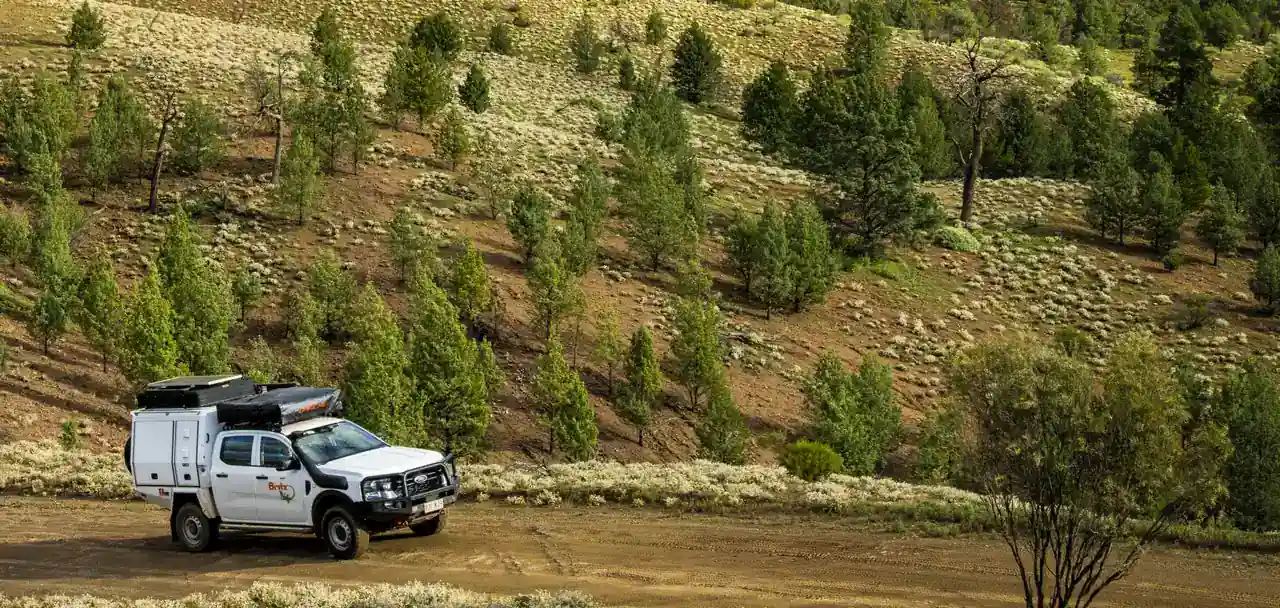
Britz’s genuine 4x4: a double cab with low range, two rooftop tents, a pull-out kitchen with sink and two-burner stove, fridge, 270° awning, bullbar and snorkel. No toilet or shower on board. Bookable in all eight cities, including Darwin and Broome. The cheapest 4x4 with a rooftop tent is the Indie Campers Adventure Standard, from about €89.
Verified against live availability in our search: 4x4s with the tent already fitted that you can actually book for pick-up in these eight cities.
Blue Mountains loops, the South Coast run and the East Coast hop north, all from one depot.
The Great Ocean Road, the Grampians and the Victorian High Country within a day of pick-up.
Four 4x4s to compare for the Gold Coast hinterland, the Sunshine Coast and the K’gari gateway at Rainbow Beach.
The Daintree and Cape Tribulation, the Atherton Tablelands and Cooktown by the inland road.
Five 4x4s from Britz, Indie, Campervan Village and Allstar (on request) for Margaret River, the Pinnacles and the Coral Coast to Ningaloo.
The Top End base for Kakadu, Litchfield and Nitmiluk, at its best in the dry season.
Two 4x4s, the Desert Sands and the Warrior 4WD, for the Flinders Ranges, the Kangaroo Island ferry from Cape Jervis and the Barossa.
A small three-vehicle fleet, dry season May to October, for the Dampier Peninsula and Cape Leveque.
Beach-town campgrounds the whole way up, short driving days, and a tent that packs down faster than the morning coffee. The classic first trip.
Designated campgrounds under big skies, croc-safe swimming holes and the only season that matters up north. Book sites ahead in the dry.
A first stop at Lancelin’s dunes, then the sealed run north with campgrounds all along the turquoise water. Sunset from the roof, every night.
Ready to Explore Australia?
Start your adventure today. Compare rooftop-tent 4x4s, find the best deal, and drive the roads less travelled.
Search Rooftop Tent Campers NowSealed-road Australia is covered by our general campervan guide. This one is about doing it with your bed on the roof: driving with the tent folded down, picking a level spot at the end of the day, and the small habits that make rooftop camping easy to live with.
Rule one is not negotiable: the tent travels folded and latched, every time. Opening it is a job for camp, never for the road. Even folded, it is a solid box up top, so the vehicle carries a higher centre of gravity and catches more wind than the same 4x4 bare. None of that is dramatic on tar or gravel, it just rewards smooth, unhurried driving.
This is where the rooftop tent earns its keep. Setup is a few minutes once you have done it twice: unlatch, fold out, climb the ladder. There is no hunting for a flat, rock-free tent pad, because your floor is the vehicle. What matters instead is where the wheels sit: a level parking spot beats a pretty one, since every degree of lean under the tyres becomes a slope under your mattress.
Government permits and your rental company’s own approval are two separate layers. Clearing one does not clear the other, and the second one is the one that voids your cover if ignored. With a rooftop tent vehicle the operator’s list of barred routes does most of the deciding, so read it before you sketch the route.
Outback trip planning is logistics, not navigation. The roads are obvious, the distances are not: stretches between roadhouses can run to hundreds of kilometres, and mobile coverage drops away fast once you leave the highways. The tent adds one small line to the daily routine, pack-down before you move, and it is a few minutes with the bedding folded away inside.
A hired rooftop tent setup comes ready to sleep in, but what is in the back varies by operator, and the habits that keep the tent dry and the roof happy are yours to bring.
Explore the best places to rent a campervan, motorhome, or RV worldwide