English
Compare real-time 4WD availability across Australia in one search.
First trip to Australia? US$50 off·NEW50
The 4WD season is the dry season. Book months ahead: the outback-ready fleet is small and sells out first.
Gibb River Road country. April–May has full waterfalls; June–July brings warm days and cool nights. By October daytime heat passes 40 °C.
Uluru, Kings Canyon and the Mereenie Loop are at their best in the cooler months. Summer heat makes remote tracks genuinely dangerous.
Munga-Thirri closes every summer (1 Dec–15 Mar) and requires a Desert Parks Pass. Most rental fleets restrict it; ask before you plan a crossing.
The wet season closes the Cape: rental companies bar it from December to May, and the rest of the year they ask for written approval first. November is open on paper, but the pre-monsoon build-up makes it a gamble.
Australia’s highways are sealed: for many trips a regular campervan is enough. These are the places where a 4WD stops being optional.
4WD-only beyond the resort zones. Queensland requires a Vehicle Access Permit (about A$58 per month) and a camping permit if you stay overnight.
Roughly 660 km of unsealed Kimberley track between Derby and Kununurra. Gorges, river crossings and corrugations: this is the classic reason to hire a 4WD.
The unsealed shortcut on the Red Centre Way. Crosses Aboriginal land, so you need a transit pass (a few dollars, valid 3 days, sold locally).
The serious expeditions. Both sit behind seasonal closures, permits and your rental company’s own approval, check the terms before building a route around them.
One honest warning: every rental company restricts where you can take a 4WD. Britz requires written permission for the Gibb or Cape York and bans the Old Telegraph Track outright; Apollo wants your remote route declared at the branch. Break the rules on an off-road trail and the damage bill is yours, and unsealed-road damage is often excluded from standard cover. Comparing those rules side by side is exactly what this page’s search is for.
Verified against live availability in our search: 4WD campers you can actually book for pick-up in these seven cities.
Gateway to Kakadu, Litchfield and the Gibb. The most in-demand 4WD depot in the country during the dry.
Start point for Cape York and the Savannah Way west.
The west-coast run: Ningaloo, Karijini and, for the committed, the southern end of the Gibb.
Stockton Beach and the Worimi sands two hours north, plus Myall Lakes and the Watagans.
Gateway to the Victorian High Country, where the tracks open from November to April.
The sand-island city: Moreton, Bribie, Cooloola and the barges to K’gari.
The southern gateway to the Flinders Ranges and the outback tracks.
We only list what our booking engine can actually confirm. Right now that means eight 4WD models, from compact expedition campers to double-cab 4x4s with rooftop tents, from about €89 a day, with availability that varies by city and season, run the search for your dates to see everything live. Prefer sleeping on the roof? See: 4x4 with Rooftop Tent Hire Australia. Choosing between companies? See how the Australian campervan hire companies and their 4WD fleets compare.
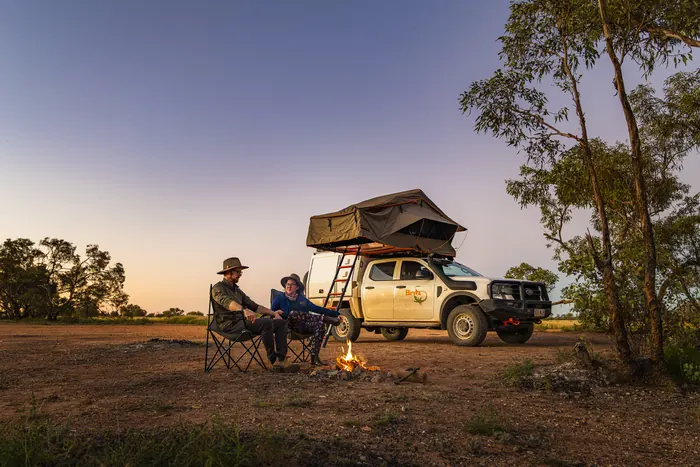
A proper high-clearance 4x4 camper for two. Exact spec and extras are confirmed at booking, and availability genuinely varies by city and season: if your dates show nothing, try Darwin or Cairns, or shift a week.
Derby to Kununurra through the Kimberley: Windjana, Bell Gorge, El Questro. Dry season only, and only with your rental company’s written permission, handed over at pick-up.
75 Mile Beach, Lake McKenzie and the inland tracks of the world’s largest sand island. Permit required, tides rule the timetable.
Alice Springs to Uluru via Kings Canyon on the Mereenie Loop, the unsealed section needs the transit pass and rewards it.
Ready to Explore Australia?
Start your adventure today. Check live prices, find the best deal, and drive the roads less traveled.
Search Campervans NowSealed-road Australia is covered by our general campervan guide. This one is about what changes when you leave the tar: tracks, permits, bush camps and the habits that keep a 4WD trip fun.
The surprise for most first-timers is not difficulty, it is distance and vibration. Corrugated gravel shakes everything loose, bulldust hides holes, and a crossing that was easy yesterday can be flowing today. Drop your speed on gravel, engage 4WD before you need it, and treat every water crossing as unknown until proven otherwise.
The point of a 4WD camper is sleeping where the crowds cannot reach: national park campgrounds at the end of gravel roads, station stays on working cattle country, and the beach camping zones of K’gari. The rules are stricter than the scenery suggests, and rangers do check.
Government permits and your rental company’s own approval are two separate layers. Clearing one does not clear the other, and the second one is the one that voids your cover if ignored.
Outback trip planning is logistics, not navigation. The roads are obvious, the distances are not: stretches between roadhouses can run to hundreds of kilometres, and mobile coverage drops away fast once you leave the highways.
A hired 4WD camper comes trail-ready, but what is in the back varies by operator, and the habits that keep you out of trouble are yours to bring.
Explore the best places to rent a campervan, motorhome, or RV worldwide