Call us
Language & Currency
Language
Campervan and motorhome rental in the United Kingdom English
English Default

Currency
All Destinations
Limited time only! Get a free 1GB eSIM* with your campervan booking. T&Cs apply.

Green Campers Iceland's electric campervan specialist

Green Campers is Iceland's electric campervan specialist, running a fleet powered by 100% renewable Icelandic electricity for near-zero-emission road trips along the Ring Road, Golden Circle and South Coast. Pick up your camper in Reykjavík's Grandi harbour district, minutes from the old harbour and an easy transfer from the city. Every van comes with a complete camping, kitchen and sleeping kit included, bedding, cooking gear and all.

5.0Google rating (9)
100%Electric & hybrid
up to 420 kmID. Buzz range
from €100per day
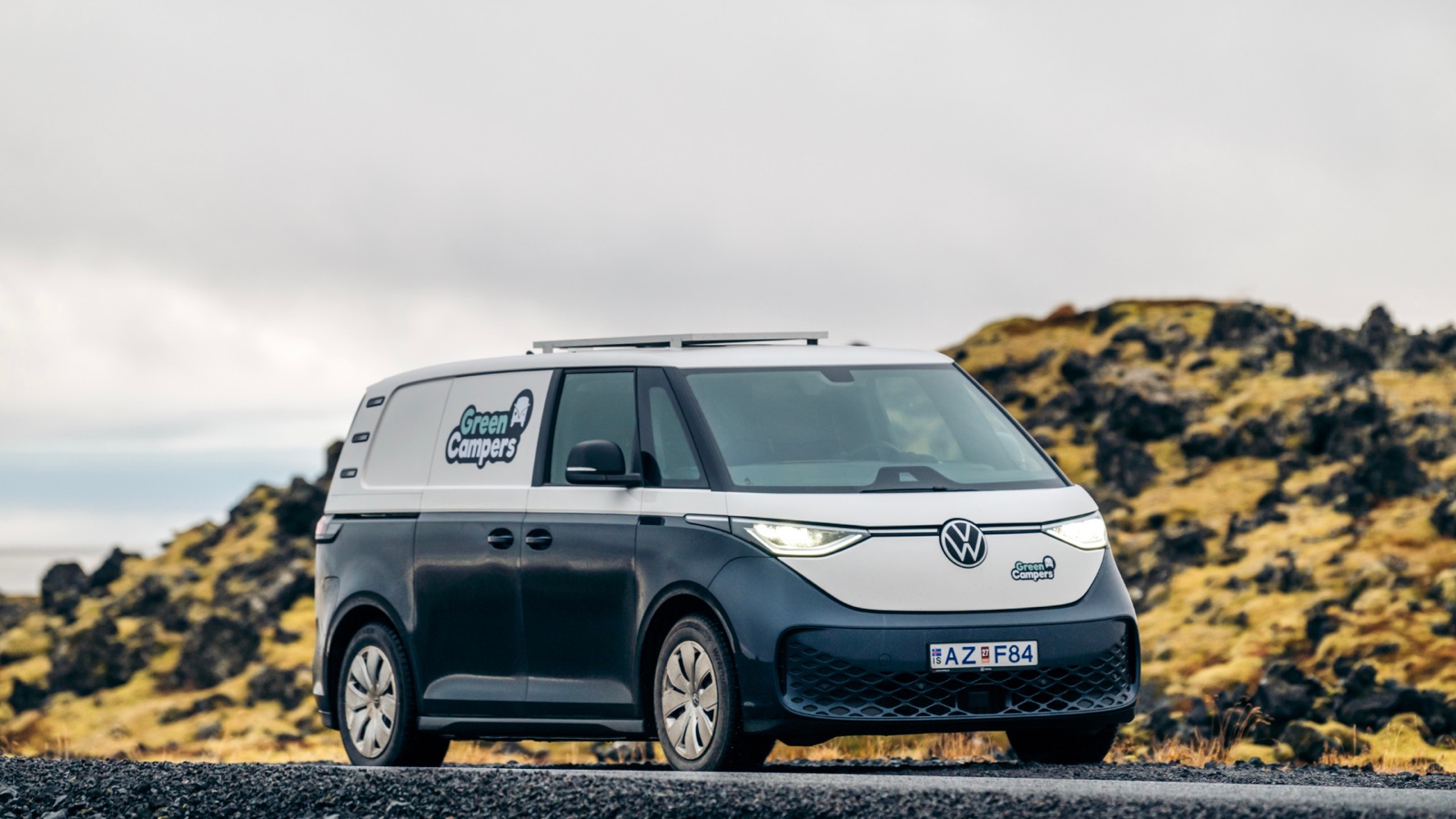
Green Campers electric VW ID. Buzz campervan in the Iceland lava fields

Who is Green Campers?

Green Campers is Iceland's electric and hybrid campervan specialist, based at Fiskislóð 33 in Reykjavík's Grandi harbour district, a short walk from the old harbour and about 45 minutes from Keflavík Airport. While most Icelandic rental fleets still run on diesel, Green Campers built its identity around a single, uncompromising idea: that a road trip through one of Europe's last great wildernesses should leave the landscape exactly as it found it. Every camper it rents is powered by 100% renewable Icelandic electricity, making a near-zero-emission journey around the island not just possible, but genuinely practical.

The fleet is deliberately small and purposeful, three camper models, from a compact electric couples' van to a hybrid family camper with a rooftop tent, each fitted out with a complete camping, kitchen and sleeping kit so you can collect the keys and drive straight to your first night under the northern sky. These are two-wheel-drive electric and hybrid vans, which means they are built for Iceland's paved routes: the Ring Road, the Golden Circle, the South Coast, Snæfellsnes and Reykjanes, rather than the 4x4-only F-roads of the Highlands. Within that world of sealed roads and coastal drama, they cover an enormous amount of the country's best scenery. The season runs from April to October, and 24/7 roadside support means help is a phone call away wherever the road takes you.

What makes an electric camper make unusual sense here, of all places, is Iceland itself. This is a country that generates virtually all of its power from geothermal and hydro sources, so charging a battery is both remarkably cheap and genuinely clean, you are quite literally driving on the same volcanic and glacial energy that shaped the scenery outside the windscreen. The vans are near-silent, which changes how you experience a place defined by its quiet: you pull up beside a waterfall or a black-sand beach and hear the water and the wind, not an idling engine. For travellers who come to Iceland precisely because of its raw, unspoilt nature, choosing a Green Campers vehicle is less a compromise than a natural extension of the trip's whole reason for being.


Why an electric camper in Iceland?

Electric vehicles are only as clean as the grid that charges them — and this is exactly where Iceland changes the equation. The country's electricity is generated almost entirely from hydropower and geothermal energy, a grid that is essentially 100% renewable. Plug an electric camper into that grid and the emissions math genuinely works out: you're driving on the same clean energy that lights the country, not on electricity quietly produced by a fossil-fuel power station somewhere upstream. That's the honest case for going electric here, and it's one very few destinations in the world can make.

The everyday experience is just as persuasive. Charging an electric van costs a fraction of filling a tank of petrol, so your "fuel" budget drops sharply over a week-long Ring Road loop. The drive itself is silent and smooth — no engine drone as you roll past waterfalls, lava fields and empty coastal roads, which suits Iceland's quiet, wide-open landscapes far better than a diesel rumble. And an electric drivetrain delivers instant torque and instant cabin heat, a real comfort on cold, windy mornings when you want warmth the moment you set off.

There's a values dimension too. Iceland takes nature protection seriously — off-road driving is illegal, fragile moss and highland terrain are fiercely guarded — and travelling in a low-emission, low-noise camper fits that ethos naturally. The one honest caveat: you'll need to plan your legs around range and charging. Iceland's fast-charging network along the Ring Road is growing steadily, but stops are further apart than in mainland Europe, so a little forethought — charging while you eat, sleep or sightsee — turns range from a worry into a non-issue.

  • Genuinely low-emission — charged on Iceland's ~100% renewable hydro-and-geothermal grid, unlike EVs plugged into fossil-heavy grids elsewhere.
  • Cheaper to run — charging costs far less than petrol, trimming your on-the-road spend.
  • Silent, smooth driving that matches Iceland's quiet, open scenery instead of intruding on it.
  • Instant heat and instant torque — quick cabin warmth and responsive pulling power for cold, blustery days.
  • In step with Iceland's nature-first ethos — a low-noise, low-emission way to explore a country that protects its wilderness closely.
The fleet

Three electric & hybrid campers

Green Campers runs a focused, modern fleet, pick by berths, budget and range. All are 2WD vans built for Iceland's paved routes (not F-roads), and all come with the full camping, kitchen and sleeping kit. See how it compares in our guide to the best campervan rentals in Iceland.

VW ID. Buzz Cargo

from €145/day
Electric3 berthsup to 420 km

The fully electric VW ID. Buzz Cargo is Green Campers' most iconic ride, a modern reimagining of the classic VW van, now silent and zero-emission. With three berths and a custom-fitted camper interior, it suits a couple wanting extra space or a small family of three, and it's a natural fit for design-lovers drawn to its clean, retro-futuristic lines. On the road the experience is distinctive: quiet, smooth, and quick off the mark thanks to instant electric torque, making long Ring Road and South Coast days genuinely relaxing. It comes with the complete camping, kitchen and sleeping kits, so you're ready to cook and sleep out of the box. One honest caveat: this is a 2WD electric van built for paved routes, the Ring Road, Golden Circle, Snæfellsnes, not Iceland's 4x4-only F-roads. With up to 420 km of range, plan your legs around Iceland's growing Ring Road fast-charging network.

VW Multivan T7

from €150/day
Hybrid5 berthsExtended (hybrid)

The most versatile van in the Green Campers fleet, and the one built for a full family. The plug-in hybrid VW Multivan T7 sleeps five once the rooftop tent is pitched, making it the natural pick for parties of four or five and for longer Iceland itineraries. Its hybrid drivetrain is the practical advantage here: on long Ring Road days you keep the flexibility of extended range and fewer charging stops, without giving up the low-emission ethos that defines the brand. Inside, the cabin is spacious and adaptable, and every trip includes the complete camping, kitchen and sleeping kits, plus the camping box and rooftop tent for those extra sleepers. One honest caveat: like the rest of the fleet, it's a 2WD vehicle meant for paved routes, the Golden Circle, South Coast, Snæfellsnes and the Ring Road, not Iceland's 4x4-only F-roads. From €150 per day.

BYD ETP3

from €100/day
Electric2 berthsup to 310 km

The BYD ETP3 is Green Campers' entry point: a fully electric two-berth camper from €100 a day, their most affordable van and the greenest way to see Iceland. It's built for couples and solo travellers who want the lowest price and the smallest footprint on the southwest's paved loops, the Golden Circle, the South Coast, Reykjanes and Snæfellsnes. Compact and light, it's genuinely easy to drive and simple to park in tight harbour towns and trailhead lots. A camping box slots into the setup, and every rental includes the complete camping, kitchen and sleeping kits, so you arrive to cook and sleep with nothing extra to buy. Be realistic about range: up to 310 km per charge means planning stops around Iceland's growing Ring Road fast-charging network on longer legs. It's ideal for shorter loops and southwest touring, paved roads only, not F-roads (2WD electric).

Charging & range: planning an electric Iceland road trip

Iceland is one of the most electric-friendly places on earth to take a campervan, precisely because its electricity is drawn from renewable geothermal and hydroelectric sources. A growing fast-charging network follows the Ring Road (Route 1) and clusters densely across the populated southwest, so the classic touring routes are well served. The trade-off is simple honesty: coverage thins out in the remote east and far north, and the deep Highlands have essentially none. That is no obstacle for these vans, because the Highlands and their F-roads are 4x4-only territory and off-limits to a 2WD electric or hybrid camper anyway. In practice, you match your itinerary to the network and to the van's range, and Iceland's most celebrated scenery falls comfortably within reach.

Range is the number that shapes each day's plan. The fully electric VW ID. Buzz Cargo covers up to 420 km, which is more than enough for generous daily legs with a comfortable buffer; the compact BYD ETP3 offers up to 310 km, ideal for couples doing shorter hops between charge points; and the VW Multivan T7, being a plug-in hybrid, sidesteps range anxiety entirely by falling back on fuel when a charger isn't nearby. Whichever you choose, the paved southwest is genuinely EV-friendly. The Golden Circle, the South Coast, Reykjanes and Snæfellsnes all sit on well-charged, sealed roads, so a first electric road trip in Iceland can be as relaxed as any conventional one.

The rhythm that works best is unhurried: think in terms of one good charge overnight and a top-up during the day, rather than long anxious dashes between stations. Many campsites offer power hook-ups where you can recharge while you sleep, and towns along the route typically have public chargers to bring you back up before the next leg. Plan each day around the van's realistic range rather than its maximum, keep a sensible reserve in hand, and the electricity itself is close to free of emissions, the quiet, clean way to see the country.

  • Start each day fully charged. Recharge overnight at your campsite so you set off with maximum range and the most flexibility.
  • Book campsites with power hook-ups. Reserve pitches that offer electricity, especially in shoulder-season and busier areas, so overnight charging is guaranteed.
  • Download a charging-map app. Keep a live map of charge points on your phone to find the next station and check availability before you commit to a leg.
  • Keep a 20% buffer. Plan to arrive at each charger with roughly a fifth of your range in reserve, weather, headwinds and detours all draw a little extra.
  • Top up in towns and at highway stops. Add range opportunistically when you stop for supplies, food or a break, rather than waiting until the battery runs low.
  • Match the route to the van. Stick to the paved southwest and Ring Road; leave the Highlands and F-roads to 4x4 vehicles, where these vans aren't meant to go.

What's included with every Green Campers rental

Green Campers keeps the essentials simple: every van, from the compact BYD ETP3 to the family-friendly VW Multivan T7, comes trip-ready with a complete camping kit so you can drive off and start living out of it the same day. Here's what's in the van when you collect it, and what to confirm at booking.

  • Sleeping: a full sleeping kit with bedding for every berth.
  • Kitchen: a kitchen kit with cooking gear, so you can prepare meals on the road.
  • Camping: a complete camping kit for life outside the van. The BYD ETP3 and the VW Multivan T7 also come with a camping box, and the Multivan T7 adds a rooftop tent for extra sleeping and flexibility.
  • Support: 24/7 roadside support from the provider throughout your trip.

Some things vary by model and are best confirmed when you book. Insurance and coverage specifics, along with any optional extras such as ready-made 3-, 5- or 7-day itineraries, should be checked at booking so you know exactly what's covered and what's typically added on top.

Pickup in Reykjavík: Fiskislóð 33, Grandi

Green Campers hands over your van at Fiskislóð 33, in the 101 Reykjavík postcode, in the heart of the Grandi old-harbour district on the western edge of the city. This is a city pickup, not an airport desk: your camper is waiting in town, a short walk from the old harbour rather than at the Keflavík Airport (KEF) arrivals hall. It's worth being clear on that distinction before you fly, because KEF sits roughly 45 minutes' drive southwest of the capital, so you'll need to cover that stretch under your own steam first.

Green Campers does not advertise a dedicated airport transfer, so treat the KEF-to-Reykjavík leg as something you arrange yourself. The most common options are the scheduled airport coach (the Flybus and similar services run in step with flight arrivals) or a taxi, both of which take around 45 minutes into the city. The upside of a Grandi base is real: this is a lively, regenerated harbour quarter with cafés, eateries and a handful of attractions, so once you've collected the keys you can stock the camper with groceries in town, grab a coffee, and roll out already provisioned rather than scrambling for supplies on the road.

  • Plan the transfer: KEF to Grandi is about 45 minutes by airport coach (Flybus-style service) or taxi, arrange it yourself, as no shuttle is provided.
  • Arrive with time to spare: give yourself a buffer around the handover so you're not rushing the walkthrough of an unfamiliar electric van.
  • Provision in the city: buy your groceries and trip supplies near the base before you leave town, it's easier here than out on the Ring Road.
  • Top up first: plan your first charge before or as you leave the capital, so you set off on the Ring Road with range in hand.
  • Drop-off: the return is back to the same city base at Fiskislóð 33, so factor the reverse transfer to KEF into your departure-day timing.

Where a Green Campers electric camper takes you

Iceland's south and west are laced with smooth, sealed roads that were practically made for a quiet electric van, and a fast-charging network now threads the Ring Road at the towns and service stops where you'd naturally break for coffee. Green Campers offers ready-made 3-, 5- and 7-day itineraries, and each one keeps you firmly on paved tarmac, well within a 2WD electric or hybrid van's comfort zone. The Highlands and their F-roads are 4x4-only country and stay off the map here; everything below is asphalt from door to door. The rhythm is simple and civilised: drive a scenic leg, plug in while you eat or explore, roll on charged. Here is how the three trips unfold.

3-day: Golden Circle, Reykjanes and the South Coast to Vík

A tight, greatest-hits loop that never strays from paved roads. Day one leaves the Grandi harbour base in Reykjavík for the classic Golden Circle, Þingvellir National Park, the Geysir hot-spring field and the thunder of Gullfoss, an easy 250–300 km round of gentle Ring Road and Route 35 tarmac, with charging at Selfoss to top up before or after the loop. Day two swings south down the Reykjanes peninsula to the Blue Lagoon and its lunar lava fields, a short paved run that pairs naturally with a slow recharge while you soak. Day three follows Route 1 along the South Coast, past the waterfalls of Seljalandsfoss and Skógafoss to the black-sand beaches of Reynisfjara and the village of Vík, roughly 190 km each way, with chargers at Hvolsvöllur and Vík to keep the return relaxed. Sealed roads throughout, ideal for the compact BYD ETP3 or the ID. Buzz.

5-day: South Coast extended to Jökulsárlón, or a Snæfellsnes detour

Two more days turn the highlight reel into a proper journey, and both options stay entirely on tarmac. Push east: continue on Route 1 beyond Vík across the Skeiðarársandur plains to Skaftafell in Vatnajökull National Park, then on to the Jökulsárlón glacier lagoon and the glinting ice of neighbouring Diamond Beach, a spectacular ~370 km run each way from Vík, so break it over two days with an overnight around Kirkjubæjarklaustur or Höfn, both of which have charging. Prefer the west? Trade the far east for the Snæfellsnes peninsula, Kirkjufell mountain, the Arnarstapi cliffs and the glacier-crowned tip, a fully paved circuit reachable in a couple of hours from Reykjavík, with top-ups in Borgarnes and Ólafsvík. The plug-in Multivan T7, with its hybrid range flexibility, is the easy pick for these longer legs.

7-day: the full paved Ring Road loop

A week is enough to circle the whole island on Route 1 without touching a single gravel F-road, Iceland's Ring Road is sealed the entire way round. Pace it honestly for an electric van: think five manageable driving days of roughly 200–300 km rather than marathon stints, so range is never a worry and charging always lands at a natural stop. A comfortable clockwise rhythm runs Reykjavík to Vík, on to Höfn and the glacier lagoon, north to the Eastfjords and Egilsstaðir, across to Mývatn and the Goðafoss–Akureyri stretch, then down through the west via Borgarnes back to base. Charge over lunch and overnight stops in the ring towns, Vík, Höfn, Egilsstaðir, Akureyri, Borgarnes, and the batteries stay ahead of the road. For this all-terrain-free grand tour the hybrid Multivan T7 gives the most headroom, though a well-paced ID. Buzz handles the loop beautifully too.

Season: April to October

Green Campers runs a defined driving season that stretches from April to October, and the electric-camper experience shifts meaningfully across it. In April–May you catch the shoulder: quieter roads, lower prices and a landscape where the peaks are still capped with snow while the lowland paved routes open up. Daylight is already building fast toward the midnight-light of summer, which gives you long, unhurried driving windows to plan charging legs around. By June–August the country hits its peak, the midnight sun keeps the sky bright almost around the clock, every paved route is open, and campsites are fully operational. For an electric camper this is the sweet spot: near-endless daylight makes it easy to plan range-conscious legs along the Ring Road, Golden Circle and South Coast without racing the light.

September–October book-end the season with autumn colour across the lowlands, the first early northern lights returning to darkening skies, and cooler, quieter conditions as the summer crowds thin out. Be honest with yourself about the trade-offs, though: campsite availability and daylight both shrink as you move toward October, so late-season trips need tighter planning, and Icelandic weather is variable at any point in the season, pack and drive for changeable conditions. Across all of it, the paved-route season is exactly what suits a 2WD electric or hybrid van: these campers are built for the sealed Ring Road, Golden Circle, South Coast, Snæfellsnes and Reykjanes rather than the Highland F-roads, and the April-to-October window is precisely when those paved routes are open, charging is straightforward, and the driving is at its best.

Is Green Campers right for you?

Green Campers is a specialist, not a generalist, it does one thing, the electric road trip, exceptionally well. That focus makes it a perfect fit for some travellers and the wrong call for others. Here's an honest read on which camp you fall into before you book.

Great if you…

  • Want the lowest-emission way to see Iceland, powered by 100% renewable Icelandic electricity.
  • Are sticking to paved routes, the Ring Road, Golden Circle, South Coast and Snæfellsnes.
  • Are travelling as a couple or a small family who don't need a fleet of berths.
  • Value a quiet, modern van and a smooth, near-silent drive.
  • Like the idea of starting your trip right in Reykjavík, walkable to the old harbour.
  • Want your camping, kitchen and sleeping kit included so you can just pack and go.

Look elsewhere if you…

  • Need 4x4 capability for F-roads or the Highland interior, these 2WD electric and hybrid vans aren't built for it.
  • Want a large 6-berth motorhome for a bigger group.
  • Expect to collect your van at an airport desk, pickup is in Reykjavík, roughly 45 minutes from Keflavík.
  • Are planning very long, remote days where charging is sparse and range anxiety would take the fun out of the drive.
CampervanPlanet verdict

Green Campers is our pick for eco-conscious travellers who want the lowest-emission, quietest way to tour paved Iceland from Reykjavík, with a tight three-model electric and plug-in hybrid fleet running on 100% renewable Icelandic power. It's not the choice for F-road or Highland trips or big-motorhome needs, these 2WD vans are built for the Ring Road, Golden Circle, South Coast, Snæfellsnes and Reykjanes. Best fit: the environmentally minded couple or small family sticking to Iceland's paved routes who want to travel green without compromise.

Good to know

Green Campers FAQ

How much does it cost to rent a Green Campers electric camper?+

Green Campers' three models start at different from-prices: the compact, fully electric BYD ETP3 begins at €100/day, the iconic all-electric VW ID. Buzz from €145/day, and the hybrid VW Multivan T7 from €150/day. These are indicative starting rates, the exact figure depends on the model you choose, how long you travel, and when you go. Peak summer commands more than the shoulder months of the April–October season, so booking well ahead is the most reliable way to secure the lower end of the range.

Which Green Campers van is cheapest?+

The BYD ETP3 is the most affordable in the fleet, starting from €100/day. It's a fully electric, two-berth camper built for couples and solo travellers, and it comes with a camping box plus the complete kitchen and sleeping kit. If you're a pair happy in a compact, easy-to-drive van, it's the natural entry point. Larger groups who need the ID. Buzz (from €145/day) or the five-berth hybrid Multivan T7 (from €150/day) will pay more, but gain berths and space.

What affects the final price?+

Three things move the number most: which model you pick, the length of your trip, and the travel dates. Iceland's camper season runs April to October, and high summer is busiest, so the same van typically costs more in July than in the quieter shoulder weeks. Booking ahead helps in two ways, you lock in availability and you're more likely to catch the lower from-prices before peak dates fill. We've kept exact totals, deposit amounts and insurance figures off this page because they vary by dates and options; you'll see the full, transparent breakdown when you check live availability.

Is an electric camper cheaper to run in Iceland?+

Generally, yes, charging tends to be cheaper than filling a tank with petrol, largely because Iceland's electricity comes from abundant, low-cost renewable sources (geothermal and hydro). Both electric models, the BYD ETP3 and the VW ID. Buzz, run purely on that clean grid, while the plug-in hybrid Multivan T7 lets you charge and top up with fuel for extra range flexibility. Beyond the running-cost saving, you're travelling with a near-zero-emission footprint, the core reason many visitors choose an electric camper for the Ring Road and Golden Circle.

What's the range of Green Campers' electric campers?+

It depends on the model. The fully electric VW ID. Buzz offers up to 420 km of range on a full charge, while the compact BYD ETP3 does up to 310 km, real-world figures that shift with speed, weather and how much wind Iceland decides to throw at you (usually plenty). The third option, the plug-in hybrid VW Multivan T7, adds a petrol engine, so it removes the range question entirely and is the reassuring pick if you'd rather not think about charging at all. For the electric vans, think in daily legs rather than marathon drives: most Ring Road itineraries break naturally into stretches that fit comfortably within a single charge.

Where do I charge an electric camper in Iceland?+

Iceland's public charging network has grown quickly and is now well established along Route 1 (the Ring Road) and throughout the populated southwest, Reykjavík, the Golden Circle, the South Coast, Reykjanes and Snæfellsnes. Fast chargers cluster around towns, fuel stations and popular stops, so topping up while you grab a coffee or a hot dog is realistic on most routes. The easiest rhythm, though, is to charge overnight: many campsites offer electric hook-ups, so you wake up with a full "tank." Best of all, Iceland's grid runs almost entirely on renewable hydro and geothermal power, so every kilometre you drive is close to emission-free.

Will I get range anxiety on the Ring Road?+

Honestly, a little planning goes a long way, and once you have a rhythm, the worry fades fast. The trick is to plan your legs in advance: know where your next charger is before you set off, charge whenever you stop rather than waiting until you're low, and use campsite hook-ups to start each day full. Charging is denser in the southwest and thinner in remote stretches such as the east and northern interior fringes, so those sections deserve a bit more forethought. If the idea of planning charges still puts you off, the hybrid Multivan T7 sidesteps range anxiety completely while keeping the eco credentials of a plug-in.

Is it hard to drive an electric van in Iceland?+

Not at all, if anything, it's easier. These vans are automatic, quiet and smooth, with instant, predictable acceleration that suits Iceland's rolling paved roads. There's no clutch, no gear-changing and no engine noise drowning out the scenery. One honest caveat: these are 2WD electric and hybrid vans built for the paved network, the Ring Road, Golden Circle, South Coast, Snæfellsnes and Reykjanes, and not for the 4x4-only F-roads of the Highlands. Stick to the sealed routes and you'll find an EV one of the calmest, most effortless ways to explore the island.

What insurance comes with a Green Campers rental?+

Every Green Campers rental includes insurance cover as standard, and additional protection options are available if you'd like to lower your liability further. Because the exact package, excess (deductible) and any optional upgrades can vary by vehicle and season, the specific terms are confirmed on your quote at the time of booking. We'd always recommend reading the coverage details and excess amount on your booking confirmation so you know precisely what's protected before you set off on the Ring Road.

Is there a deposit?+

As with virtually all campervan rentals in Iceland, a refundable security deposit is typically held for the duration of your trip and released after the camper is returned in good condition. The exact deposit amount and how it's held depend on the vehicle and your chosen insurance option, so rather than quote a figure that may not apply to you, we show the precise deposit and payment terms on your quote when you book. Check those details at confirmation so there are no surprises at pickup.

What extras can I add to my trip?+

The essentials are already included: every Green Campers camper comes with a complete camping kit, kitchen kit and sleeping kit (bedding and cooking gear), so you can leave home lighter. Beyond that, Green Campers offers ready-made 3-, 5- and 7-day itineraries, which are a genuinely useful way to plan a route around a camper's driving range and Iceland's paved highlights. Any further optional extras and their prices are shown alongside your vehicle during booking.

What happens if the camper breaks down?+

You won't be left stranded. Green Campers provides 24/7 roadside support for the duration of your rental, so if you run into a mechanical issue anywhere on your route you can reach assistance at any hour. Keep the support details from your booking confirmation handy in the camper, and if anything goes wrong, get in touch straight away so the situation can be sorted as quickly as possible.

Where do I pick up a Green Campers camper?+

Pickup is at the Green Campers base at Fiskislóð 33, 101 Reykjavík, in the Grandi harbour district on the western side of the city. It's a short walk from Reykjavík's old harbour and roughly a 45-minute drive from Keflavík Airport (KEF). Note that this is a city location, not the airport, so plan your onward journey from KEF to Grandi before you arrive.

How do I get from Keflavík Airport to the Green Campers office?+

The base at Fiskislóð 33 sits about 45 minutes' drive from Keflavík Airport. The most common options are the Flybus (or a similar airport coach) into Reykjavík followed by a short taxi or local ride to Grandi, or a direct taxi from the airport to Fiskislóð 33. Allow enough time for the transfer and any luggage, and factor it into your first-day plans before collecting the camper.

Can I pick up at the airport?+

Airport pickup is not a stated option with Green Campers, collection is at the Grandi base at Fiskislóð 33 in Reykjavík. Plan a self-arranged transfer from Keflavík Airport, such as the Flybus/airport bus or a taxi (around 45 minutes), to reach the office. If you'd like to confirm any specific arrangements, do so with Campervan Planet support at the time of booking.

What time can I collect and return?+

Collection and return happen at the Fiskislóð 33 base in Reykjavík. Exact pickup and drop-off hours can vary by season and day, so confirm your specific times when you book rather than assuming a fixed schedule. Building in a little buffer around your flight and the roughly 45-minute airport transfer helps ensure a smooth, unhurried handover of your camper.

Can I drive a Green Campers van on F-roads or in the Highlands?+

No. Iceland's F-roads and the interior Highlands are restricted by law to 4x4 vehicles, and every Green Campers camper, the electric VW ID. Buzz and BYD ETP3, and the plug-in hybrid VW Multivan T7, is a two-wheel-drive van. That means the Highlands, river crossings and any route with an "F" prefix are simply off the table. It's an honest limitation rather than a drawback: these vans are built for Iceland's paved network, where the vast majority of the country's landmark scenery actually lies.

Can I do the full Ring Road (Route 1) in an electric camper?+

Yes. Route 1, Iceland's famous Ring Road, is fully paved and entirely drivable in a Green Campers van, provided you plan your legs around charging. Iceland has a growing fast-charging network strung along the Ring Road, so the practical approach is to treat charging stops the way you would fuel stops, mapped in advance, timed with meals or sightseeing, and matched to each model's range. It rewards a slightly slower, more deliberate rhythm, which suits an Iceland road trip beautifully.

Which famous sights can I actually reach?+

Almost all of the classics. From the Reykjavík base you can comfortably reach the Golden Circle, the entire South Coast, Seljalandsfoss, Skógafoss, the black-sand beach at Reynisfjara and the village of Vík, and continue east to the Jökulsárlón glacier lagoon. The Snæfellsnes peninsula to the north-west and the Reykjanes peninsula with the Blue Lagoon, just minutes from the airport road, are equally within reach. All of these sit on paved roads, so a 2WD electric or hybrid camper handles them without compromise.

Can I take the camper in winter?+

Green Campers operates an April-to-October season, so this is a spring-to-autumn rental rather than a deep-winter one. That window lines up with Iceland's longest daylight, the most open roads and the friendliest driving and charging conditions, the ideal stretch for touring the Ring Road and coastal routes by electric camper. If your heart is set on a winter trip, this isn't the vehicle for it; for the greener, brighter months, it's a natural fit.

How many people can sleep in each Green Campers van?+

It depends on the model. The fully electric BYD ETP3 is a compact couples' camper that sleeps 2. The electric VW ID. Buzz sleeps 3. The plug-in hybrid VW Multivan T7 is the family option, sleeping up to 5, its interior berths are complemented by a rooftop tent that adds the extra sleeping capacity. So whether you're a couple, a trio or a family, there's a berth count that fits.

What kitchen and camping gear is included?+

Every Green Campers van comes fully equipped, on every model. Each rental includes a complete camping kit, kitchen kit and sleeping kit, meaning cooking gear, cookware, utensils and the essentials you need to prepare meals on the road are all provided. You arrive, pack your food and clothes, and you're ready to explore Iceland's Ring Road and Golden Circle without a shopping list of extras to buy first.

What is the camping box and rooftop tent?+

The camping box is a pull-out kitchen and storage unit that keeps your cooking gear and provisions organised and easy to reach, it comes fitted on both the BYD ETP3 and the VW Multivan T7. The rooftop tent is a Multivan-only feature: it mounts on the roof and adds sleeping space above the cabin, which is how the Multivan reaches its 5-berth capacity. Together they make the Multivan the most flexible, family-friendly choice in the fleet.

Do I need to bring my own bedding?+

No. Bedding is part of the complete sleeping kit that comes included with every Green Campers van, so you don't need to pack or hire it separately. The same goes for cooking equipment, which is covered by the included kitchen and camping kits. Just bring your personal belongings and warm layers for Iceland's climate, the sleeping and cooking essentials are already on board.

When can I rent a Green Campers camper?+

Green Campers operates from April to October, the window that suits Iceland's electric and hybrid vans best. This is the country's non-winter season, when the Ring Road, Golden Circle, South Coast, Snæfellsnes and Reykjanes are at their most accessible for 2WD travel. Deep-winter rentals are not offered, so plan your trip within these months.

What's the best month for an electric camper trip in Iceland?+

It depends on what you want. June, July and August are the peak of the season, with the longest daylight of the year and the mildest conditions for driving and charging. The shoulder months either side of that peak tend to be quieter on the roads and generally cheaper, which appeals to travellers who prefer fewer crowds. Whichever month you choose, expect long, useful days for covering ground.

Do I need to book far in advance?+

For the busy summer months it's wise to reserve ahead. The fleet is small and focused: just the VW ID. Buzz Cargo, the VW Multivan T7 and the BYD ETP3, so popular dates in June, July and August can fill up. Booking early gives you the best choice of vehicle for your travel dates. In the quieter shoulder months there is usually more flexibility, but early booking still helps secure the exact camper you want.

Is an electric camper OK in Icelandic weather?+

Yes. Electric and hybrid vans handle Iceland's cool climate perfectly well, and the electricity that powers them comes from 100% renewable Icelandic sources. Do keep in mind that colder temperatures can reduce driving range somewhat, so it's sensible to plan your daily legs around Iceland's growing Ring Road fast-charging network rather than pushing the battery to its limit. Iceland's weather is famously changeable in any month, so pack warm, waterproof layers whatever the forecast.

Popular Destinations for Campervan Rental

Explore the best places to rent a campervan, motorhome, or RV worldwide

North America
Europe
Rest of World